

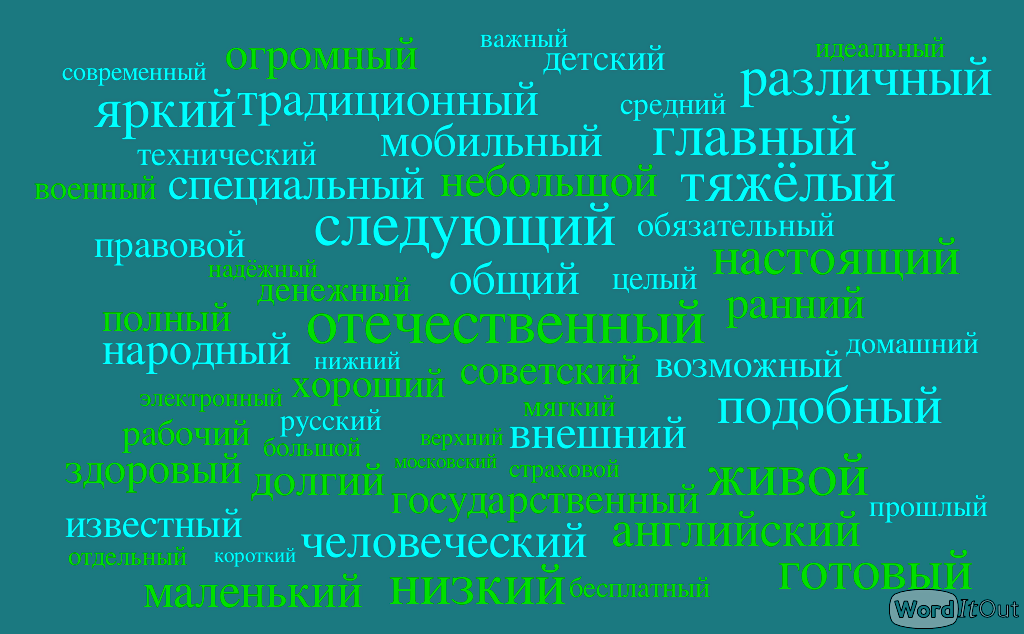
Useful, practical, interesting: adjectives are everywhere and unavoidable. So it’s worthwhile, rewarding, engaging – even essential – to be able to use them when speaking and writing. These resources and instructions will help you get started.
Forms and Endings
We’ll first look at how Russian adjectives change (forms and endings), then move on to vocabulary and usage.
Agreement in gender and number
Russian adjectives agree with the noun in gender and number. Compare: new text, new idea, new morning, new plans: новый текст (m.), новая идея (f.), новое утро (n.), новые планы (pl.).
24 possibilities
These four categories (masculine, feminine, neuter, plural), multiplied by six cases, would give 24 options for each adjective. And in a way, that’s true – and yet not quite, since many forms are identical. Then again, it almost is, because within each of those 24 options there are often two or more variants.
| masculine | feminine | neuter | plural | |
|---|---|---|---|---|
| Nom. | -ый, -ий, -ой | -ая, -яя | -ое, -ее | -ые, -ие |
| Gen. | -ого, -его | -ой, -ей | -ого, -его | -ых, -их |
| Dat. | -ому, -ему | -ой, -ей | -ому, -ему | -ым, -им |
| Acc. | -ый, -ий, -ой / -ого, -его | -ую, -юю | -ое, -ее | -ые, -ие / -ых, -их |
| Ins. | -ым, -им | -ой, -ей | -ым, -им | -ыми, -ими |
| Loc. | -ом, -ем | -ой, -ей | -ом, -ем | -ых, -их |
Which form to use depends on hardness/softness, stress, and spelling rules. For more on this, see Adjectives and Spelling Rules (Russian grammar, 2015, 3 mins) and (from the same channel) The Letters of the Three Spelling Rules of Russian (2013, 2 mins).
You may want to first watch Adjective Agreement in Russian (Nominative) (Russian grammar, 2013, 7 mins) and Adjective Endings. Adjective-noun Agreement (Amazing Russian, 2024, 24 mins). For beginners, understanding these forms in just the nominative case is already quite an achievement.
Hard and soft
The grammar behind hard/soft stems can be easily bypassed or made less urgent. There aren’t many soft-stem adjectives, and you’ll quickly recognize them. They often describe time or place. Memorize these, and you’ll already be quite far along:
- ближний (near)
- верхний (upper/high)
- весенний (spring)
- вчерашний (yesterday’s)
- дальний (far)
- домашний (home)
- завтрашний (tomorrow’s)
- зимний (winter)
- летний (summer)
- нижний (lower)
- осенний (autumn)
- передний (front)
- поздний (late)
- последний (last)
- ранний (early)
- сегодняшний (today’s)
- синий (blue)
- средний (middle)
See also Hard and Soft Stems (Amazing Russian) and Hard and Soft Consonants in Russian (Russian grammar).
More Russian Adjective Agreement
- How to agree adjectives with nouns in gender (Russian with Aurora, 2019, 9 mins)
- Russian adjectives – Tutorial (R for Russian, 2018, 14 mins), from the same channel Russian Music with Adjectives (2018, 31 mins)
- Online Russian Classroom: Gender of Adjectives (College Russian, 2018, 10 mins)
- Russian adjectives – Russian language course (Real Russian Club, 2018, 41 mins)
- Russian adjectives and their endings, declension of Russian adjectives (A. Romaker, 2018, 20 mins)
- Cases of Adjectives | Russian Language (Be Fluent in Russian, 2017, 7 mins)
Vocabulary and Usage
Grammar only comes alive when you apply it. So, build your vocabulary – adjectives are a great place to start.
Opposites
Learn adjectives in pairs that are opposites. Cold/hot, dark/light, good/bad, etc. You’ll remember them better – the words serve as reminders for each other – and you’ll learn twice as much. See Russian Antonyms.
Labeling
Label everything you see and encounter. Thin/fat, young/old, beautiful/ugly, big/small. It works with objects and people, the latter being the most fun. Just say it out loud—they probably won’t understand you anyway. Most likely.
Watch 8 Adjectives For Describing People In Russian (Russian With Max, 2018, 7 mins) and How to describe appearance in Russian (Daria Mikhay, 2018, 12 mins). See/read Describe People in Russian (Rocket Languages) and Russian Adjectives List. 50 Adjectives for Personality (Linguajunkie).
Colors
For describing objects, you’ll need words for colors. Check out Reviewing Adjectives of Color in Context: Какой? Какой цвет? Какого цвета? (Amazing Russian, 2020, 17 mins), Russian vocabulary – Colours (Learnrussian.org, 2017, 5 mins), and Russian Lesson – Learn colors in context (Russian in Context, 2013, 5 mins).
For learning adjectives, also see How to Learn a Lot of Adjectives with Minimum Effort (Amazing Russian, 2019, 12 mins) and Learn Russian adjectives: memorize 6 words in 5 minutes! Russian antonyms (Anna Cher, 2017, 5 mins).
More Russian Adjectives
Watch
- Top 50 Russian adjectives that you should know (Easy Russian, 2020, 7 mins)
- 100 Most Used Russian Adjectives with Pictures (Russian with Nastya, 2020, 14 mins), from the same channel 25 Russian Adjectives you must know (2020, 10 mins)
- 20 most used Russian adjectives & adverbs (LRW Alfia, 2019, 16 mins)
- Russian adjectives in nominative (Easy Languages, 2019, 5 mins)
- Top 15 Russian Adjectives (Be Fluent in Russian, 2017, 5 mins)
- Russian vocabulary – Adjectives (Learnrussian.org, 2017, 6 mins), from the same channel How to make adverbs from adjectives? (2018, 6 mins)
- 90 Russian common adjectives reading (Denis Fedorov, 2016, 6 mins)
- Learn the Top 25 Must-Know Russian Adjectives (RussianPod 101, 2015, 12 mins)
Check/read
- 10 Russian adjectives describing size (Learn Russian Words)
- Adjectives in Russian (Master Russian), also see Declension of Adjectives
- Declension of Russian adjectives (Learn Russian Step by Step)
- Declensions of Russian Adjectives (LRW Masha)
- Russian Adjectives (My Languages)
- Russian/Grammar/Adjectives (Wikibooks)
- Прилагательные (PS Russian)
Follow Rusland1 on X
Discover more about Russian, Russia and Russians at Rad Russia
Listen to Russian music at Music in Russian
Last updated March 26, 2026
More
Language
Learn Russian With New Channels
Language
Presenting seven new professors at YouTube University

Little Russia (Zemfira Amsterdam)
Language
The totally unprofessional report of Zemfira live in Amsterdam (November 4, 2024)

TO WORK! RUSSIAN VERB VOCABULARY
Language
Reaons and ways to work with the treasure trove of Russian verbs

Learn Russian with News
Language
The good news in all the news

Russian Propositional Case (#6)
Language
When to use the sixth of the six Russian cases

OPERATION WAR
Language
A war that has been going on for two years, and a pause that ends after three. The state of the world, and of this site.
