

The nominative case (именительный падеж) is almost a freebie in Russian. The way a word appears in the dictionary is how it appears in the Russian nominative case. ‘Nominative’ comes from nominare (to name), and in именительный you may recognize имя, meaning ‘name’.
What or who
The Russian nominative case is the unmodified or default form of a word. If nothing is being done to it in the sentence, you don’t need to do anything either.
This is my car, the book is thick: машина and книга stay as they are.
The same applies to names. Moscow is big, Putin is in charge: Москва and Путин remain unchanged.
In the sentence, these words are the subject. They answer the question what (что) or who (кто).
For more, see:
- Именительный Падеж (русский с носителем, 2020, 12 m)
- Именительный падеж РКИ. Nominative case russian (Marina, 2017, 8 m)
- Именительный падеж имен существительных (Инфоурок, 2017, 6 m)
- Nominative Case in Practice (Be Fluent in Russian, 2017, 4 m)
- Nominative case. Russian language lessons (Victoria Arysheva, 2016, 7 m)
- Nominative case. Declensions (1st, 2nd) (Ru-Land Club, 2015, 5 m)
- Russian cases – Nominative case, Russian grammar (A. Romaker, 2014, 12 m)
Read/Reference:
- The Nominative Case (Russian Lessons)
- Nominative case of Russian nouns (Study Russian Online)
Nominative Plural
For the nominative plural, the same simplicity applies. You just need to know how the plural is formed, no further modifications are required.
Masculine
- Add ы if it ends in a vowel (unless the last letter is г, к, х, ж, ч, ш, or щ — then add и instead of ы).
- If the word ends in й or ь, replace the last letter with и.
Feminine
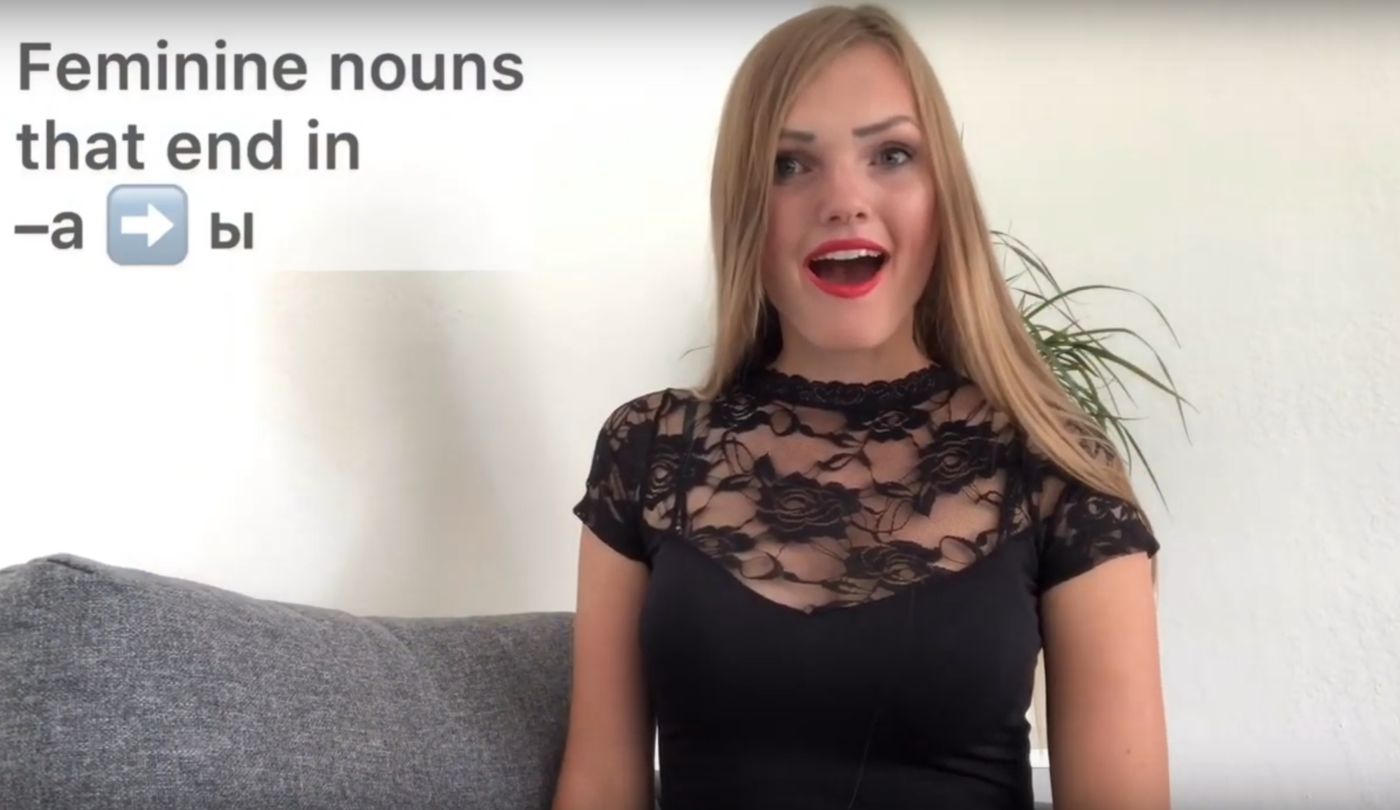
- If the word ends in а, replace the last letter with ы (unless the preceding vowel is г, к, х, ж, ч, ш, or щ — then the ending becomes и).
- If the word ends in я or ь, replace the last letter with и.
Neuter
- If the word ends in о, replace the last letter with а.
- If the word ends in е, replace the last letter with я.
Exceptions in the nominative case
There are also some irregular plurals and surprises. Some masculine words take а or я instead of ы or и. Examples include глаза (eyes), города (cities), and учителя (teachers). An ья ending appears in words like стулья (chairs), братья (brothers), and мужья (husbands). In друзья (friends), the г in друг changes to a з, and сын (son) becomes сыновья in the plural.
Some neuter words also form their plurals with ья, such as дерево (tree) becoming деревья, and крыло (wing) becoming крылья. In колени (knees) and яблоки (apples), the о changes to и. Уши (ears) sees the х in ухо turn into a ш. The words имя (name) and время (time), despite ending like feminine words, become имена and времена in plural.
For feminine words, both мать (mother) and дочь (daughter) take peculiar plural forms: матери and дочери.
Finally, some plurals follow no regular pattern. Человек (person) becomes люди (people), and год (year) turns into лет (years). This leaves plenty of room for learning. More irregular plurals can be found in Russian Language Nouns – Irregular Plural Forms (Cafe Russian, 2016, 3 mins) and Part 2 (2016, 4 mins).
Russian plurals – Russian lesson for beginners
(E-Russian, 2019, 12 m)
Beginning Russian: Plural Forms of Nouns
(Amazing Russian, 2023, 9 mins)
More on Russian plurals
Watch
- Making a Russian noun plural (Learn Russian with Olga, 2020, 6 mins)
- Russian lessons – Russian plurals (Real Russian Club, 2018, 37 mins)
- Learn plural nouns in Russian and drill professions (Maria Petrova, 2019, 7 mins)
- How to create plural form of nouns in Russian language (LMastery, 2018, 12 mins)
- Russian Nominative case – plural forms (A. Romaker, 2017, 6 mins)
- The Nominative Case: Singular and Plural (Russian Lessons with Olga, 2017, 8 mins)
- Plural nouns in the Nominative case (Key2Russian, 2014, 8 mins)
- The Plural of the Nouns in the Nominative Case (Fun Russian, 2013, 3 mins)
Check/read
- Nouns – Plural in the Nominative Case (Russian for Free)
- Nominative Plural of Nouns (Russian For Everyone)
- Plural forms of Russian nouns (Nominative Plural) (Study Russian Online)
Follow Rusland1 on X
Discover more about Russian, Russia and Russians at Rad Russia
Listen to Russian music at Music in Russian
More
Language
Learn Russian With New Channels
Language
Presenting seven new professors at YouTube University

Little Russia (Zemfira Amsterdam)
Language
The totally unprofessional report of Zemfira live in Amsterdam (November 4, 2024)

TO WORK! RUSSIAN VERB VOCABULARY
Language
Reaons and ways to work with the treasure trove of Russian verbs

Learn Russian with News
Language
The good news in all the news

Russian Propositional Case (#6)
Language
When to use the sixth of the six Russian cases

OPERATION WAR
Language
A war that has been going on for two years, and a pause that ends after three. The state of the world, and of this site.
